Can You Really Learn Pilates Online? What Distance Learning Research Says
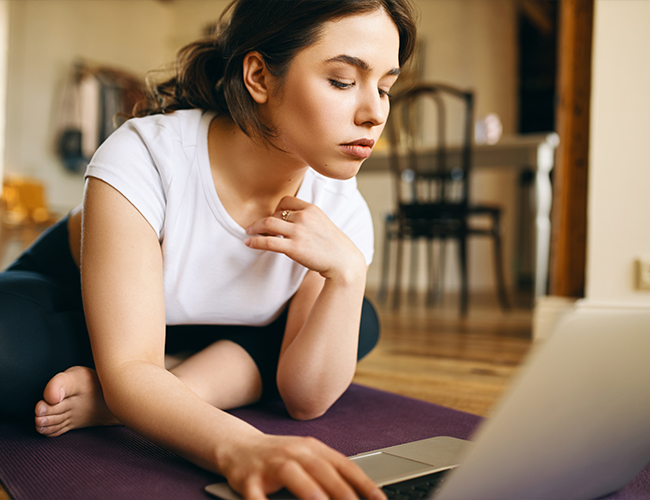
Online learning has transformed professional education in medicine, law, and engineering. Fitness took longer to follow. But the question is no longer whether you can learn online. It is whether any given program was designed well enough to actually produce a competent teacher. That depends entirely on what you are learning, and how.
Online Pilates certification can work well, but only for the right components and within a structure built around what online delivery can and cannot do. Theoretical knowledge transfers well. Physical skill acquisition needs something more: real feedback, supervised practice, and a curriculum honest about its own limits.
How Online Learning Became a Standard in Professional Education
Online education was growing long before 2020. The pandemic accelerated a shift already underway: the share of graduate students studying fully online rose from 33% in 2019 to 40% in 2023, with projections putting it at 55% by 2030.[3] But the more interesting story is which professions led the shift, and how they handled the tension between knowledge that can be learned on a screen and competency that cannot.
Medicine and nursing moved online for theory long before COVID made it necessary. A systematic review covering 6,750 students across medicine, dentistry, nursing, physical therapy, and pharmacy found that online learning produced equal or better knowledge outcomes compared to traditional instruction in the majority of studies, with one consistent caveat: hands-on clinical skills still required supervised in-person practice.[6] What changed in these programs was not whether they used online delivery, but how carefully they defined which learning objectives belonged online and which did not. Anatomy, pharmacology, and clinical reasoning can be taught at a distance. Phlebotomy, surgical technique, and patient assessment cannot be certified without someone watching your hands.
Law moved the same way. In 2015, Mitchell Hamline School of Law became the first ABA-approved law school in the country to offer a hybrid J.D., delivering doctrine online and reserving in-person Capstone Weeks for the skills work: depositions, cross-examinations, trial simulations, all requiring live practice under supervision.[7] Graduates pass the bar and practice law. The key was never the format. It was knowing what each format could and could not do.
Physical therapy programs use the same logic. Foundational science, clinical reasoning, and assessment frameworks transfer well to online delivery. Manual techniques, gait analysis, and hands-on patient care do not. Accreditation bodies across all three professions have reached essentially the same conclusion: hybrid structures work when the online and in-person components are designed around the actual learning requirements of the skill being taught, not around scheduling convenience.
Pilates followed the same trajectory. Online Pilates classes grew 35% during the COVID-19 period,[4] and demand for instructor training has continued rising, with the Pilates certification market growing at roughly 8% per year through 2030.[5] NASM, ACE, and ISSA all moved their primary certification pathways online without meaningful loss of graduate competency. The real question facing prospective students today is not whether online Pilates certification exists. It is how to tell the programs that actually prepare you to teach from the ones that simply hand you a certificate.
The same question applies to Pilates. Online certification exists. What varies enormously is whether any given program is designed around how movement skills are actually learned.
What Distance Learning Research Says About Movement-Based Skills
The philosopher Gilbert Ryle drew a foundational distinction in his 1949 work The Concept of Mind between two kinds of knowledge: knowing that and knowing how.[1] Cognitive psychologist John R. Anderson formalised this at Carnegie Mellon University in his ACT theory of cognition, giving these categories the names now standard across education research: declarative knowledge (facts, concepts, principles, terminology) and procedural knowledge (the embodied ability to actually perform a skill).[2] They are acquired differently, and online learning handles them very differently.
For declarative knowledge, the research is consistent: online learning is at least as effective as in-person instruction for most learners, and often more so, because self-paced formats let students stay with material until it genuinely makes sense rather than moving on because class time has run out. Anatomy, biomechanics, exercise physiology, Pilates principles, cueing language, client assessment frameworks, the history of the method, how exercises relate to one another across the repertoire. All of this is declarative knowledge, and all of it is well suited to online delivery.
Procedural knowledge is a different matter. The ability to read a body, cue a correction, adjust spring tension, choose the right exercise for a particular client on a particular day. Motor skill research is consistent that procedural learning needs three things that purely asynchronous formats struggle to provide: observation of expert performance, feedback on your own attempts, and repeated practice under someone who can tell you what they actually see. This constraint is not specific to fitness. Medical schools teaching surgical technique, conservatories teaching instrumental performance, and physical therapy programs all face it. Some things can only be learned by doing, under the eye of someone who knows what they are looking at.
The implication for Pilates certification is direct: any online program that delivers only declarative content and then issues a teaching certificate is certifying knowledge rather than competence. Programs worth taking are built around that distinction.
The Specific Challenges of Teaching Pilates Online
Pilates presents specific challenges for online delivery that are worth understanding before evaluating any program.
Touch and Hands-On Correction
Classical Pilates instruction is tactile. An experienced teacher places a hand on a client's back, uses a knee to guide a hip, applies pressure to create body awareness where words alone cannot reach. None of this can be replicated through a screen. Any honest assessment of online Pilates training has to say so plainly. Hands-on cueing is a skill that can only be developed with a body in front of you and a qualified teacher watching your hands.
Reading the Body in Three Dimensions
A screen shows one angle. A client in front of you is three-dimensional. Learning to see asymmetries, compensations, and movement patterns requires physical presence, which is why observation hours with real clients remain essential to any comprehensive certification regardless of how the lecture content is delivered. Power Pilates supports observation learning through live camera streams of ongoing classes at its New York City studios, giving online students direct access to real teaching in progress without requiring travel.
Equipment Familiarity
For mat-based Pilates the equipment requirement is simple: a mat, enough space, and a way to record video. For apparatus work on the Reformer, Cadillac, Chair, or Barrels, online delivery of practical skills is not feasible without the equipment in front of you. A student with no studio nearby cannot learn to set spring tension, adjust the foot bar, or spot a client on the Cadillac through video alone. This is why reputable online Pilates certifications are mat-specific, with apparatus training requiring in-person work.
Maintaining the Method's Integrity
For Classical Pilates there is one further consideration. The method is transmitted through lineage, which depends on direct observation and correction by someone trained within it. Online learning can play a role in classical training, but the online components need clear limits, and the in-person work needs to be taught by instructors with documented lineage. The two parts of the program have to be designed to fit together.
What Separates a Rigorous Online Pilates Certification From a Shortcut
These are the criteria that distinguish a well-designed online Pilates certification from one that processes enrollments without producing teachers. They apply to any program, classical or contemporary, and are worth asking of every program you consider.
Clear Scope
The program states clearly what it certifies: mat only, or apparatus included. Any program claiming to certify full apparatus teaching through purely online delivery warrants serious scrutiny.
Practice Before Teaching
Students build the method in their own body before learning to teach it. Skipping this step produces instructors who are teaching exercises they have not yet felt from the inside.
Practical Assessment
Graduates submit video of themselves teaching, reviewed by qualified assessors. Passing a multiple-choice exam is a knowledge test, not a practical assessment.
Real Feedback
A named instructor reviews your actual teaching and responds to what they see. Automated scoring cannot tell you why your cueing is not landing.
Live Teaching Practice
Students practice teaching in real-time with a Teacher Trainer present, not just by submitting video. The dynamic of teaching a moving body cannot be replicated asynchronously.
Instructor Credentials
Faculty are named with verifiable training backgrounds. For Classical Pilates, lineage is documented. Programs with anonymous or unverifiable instruction cannot demonstrate what they are actually transmitting.
| Feature | Rigorous Program | Shortcut Program |
|---|---|---|
| Scope | Clearly defined: mat or apparatus specified | Vague or overclaims apparatus coverage |
| Practice-first requirement | Students demonstrate the method in their own body before teaching it | No personal practice requirement |
| Practical assessment | Video practical exam reviewed by qualified assessors | Multiple choice exam only |
| Feedback | Named instructor reviews your teaching | Automated or no feedback on movement |
| Live practice | Live video conference sessions with Teacher Trainer | No synchronous teaching practice |
| Instructor credentials | Named, verifiable, lineage-documented (Classical) | Anonymous or unverifiable |
| Studio recognition | Recognised by professional studios worldwide | Recognition varies or absent |
How Power Pilates Structures Its Online Mat Certification
Power Pilates has trained more than 20,000 instructors across 40 countries since 1995. The Complete Mat Academy is built around the sequence described above: practice first, then conceptual grounding, then technique, then live feedback from Teacher Trainers with lineage traceable to Romana Kryzanowska and Joseph Pilates. For instructors who want to watch real classes in progress, live camera streams from the NYC studios are available to support the observation component. The Academy certifies the full classical mat repertoire. For apparatus training on the Reformer, Cadillac, Chair, and Barrels, the 600-hour Comprehensive program, which has in-person components built in, is the right next step.
Personal practice comes before teaching, conceptual study is assessed before progression, and live feedback from a qualified instructor replaces automated scoring at the point where it matters most. A scoring algorithm cannot tell you why your cueing is not landing. A Teacher Trainer watching you teach in real-time can. The difference between programs that include that step and programs that skip it is the difference between certifying knowledge and certifying competence.
Online Mat Certification vs. Comprehensive Training: The Complete Mat Academy certifies you to teach the full classical mat repertoire. For instructors who want to teach on the Reformer, Cadillac, Chair, and Barrels, the 600-hour Comprehensive program, which requires in-person components, is the right path. Many Power Pilates instructors start with the online mat certification and move into the Comprehensive program as their practice develops.
Who Online Pilates Certification Is Right For
Online certification is not the right path for every aspiring instructor. Here is a straightforward look at who it serves well and who would be better off starting in person.
Online certification makes sense if:
You do not live near a qualified Pilates training facility. You are juggling professional development with work and family commitments that make weekend intensives genuinely difficult to schedule. You already have a personal mat practice and want to formalise and deepen your teaching knowledge. You want to teach mat classes while working toward full apparatus certification over time. And you have the self-discipline to complete observation and practice hours without someone holding you to a schedule.
In-person training is the better starting point if:
You are new to Pilates and have not yet developed a personal practice. You want to teach full apparatus from the beginning. You learn best through immediate physical feedback and real-time correction. You have access to a reputable training centre and can commit to being there.
The hybrid path
Many serious instructors do both. Starting with an online mat certification builds the theoretical foundation, the classical repertoire knowledge, and the initial teaching credential while keeping the flexibility to keep working and practising. The in-person comprehensive training that follows tends to go better for having that foundation in place. This is not a compromise path. It is a sequence that a lot of Power Pilates instructors have found genuinely useful.
Frequently Asked Questions
Is an online Pilates certification recognised by studios?
It depends on the program. A weekend certification from an unaccredited provider is unlikely to be accepted at professional studios regardless of whether it was delivered online or in a room. The question that matters is not "is it online?" but "which organisation issued it, and do the studios I want to work in know and respect that organisation?" Ask studios directly before you enroll.
Can I teach Reformer Pilates after an online mat certification?
Not from a rigorous program, no. An online mat certification covers mat teaching. Reformer certification requires hands-on training because the practical skills involved cannot be meaningfully assessed at a distance. Any program claiming to certify Reformer teaching through purely online delivery should raise questions.
In the Power Pilates system, the Complete Mat Academy certifies mat teaching. Reformer and full apparatus training requires the Comprehensive program, which has in-person components built in.
How is online Pilates training assessed on the practical side?
In a well-designed program, practical assessment happens in two ways. First, students submit video recordings of themselves demonstrating the exercises and teaching the repertoire, reviewed by qualified assessors with documented training backgrounds. Second, students teach in real-time during live video conference sessions with a Teacher Trainer. The dynamic of teaching a moving body cannot be adequately captured through pre-recorded video alone.
Written exams test theoretical knowledge. Together, all three components give a genuine picture of what a graduate knows and can do.
Does online training work for Classical Pilates specifically?
For the theoretical and conceptual components, principles, history, anatomy, exercise nomenclature, sequencing logic, it works well. For practical skills the same constraints apply as with any movement education: video assessment can evaluate what appears on screen but cannot replace the tactile feedback of in-person correction.
The additional consideration for Classical Pilates is lineage. A well-designed classical online program should be taught by instructors with documented, verifiable lineage whose teaching reflects the original method. The Power Pilates Complete Mat Academy is taught by Master Teacher Trainers whose lineage traces directly to Romana Kryzanowska and Joseph Pilates.
What equipment do I need for an online mat certification?
A Pilates mat, enough space to move through the full repertoire, and a device that can record video for practical submissions. The Magic Circle appears in some mat programs and is inexpensive and easy to find. Apparatus such as the Reformer, Cadillac, Chair, and Barrels is not required for mat certification and cannot be adequately learned exclusively online regardless.
References & Sources
- Ryle, G. (1949). The Concept of Mind. Hutchinson & Co. The foundational philosophical distinction between "knowing that" (declarative knowledge) and "knowing how" (procedural knowledge). ↑ Back to text
- Anderson, J. R. (1976). Language, Memory, and Thought. Erlbaum. Formalised as the declarative/procedural distinction in Anderson's ACT theory of cognition at Carnegie Mellon University; further developed in The Architecture of Cognition (Harvard University Press, 1983). ↑ Back to text
- Validated Insights (2025), via Research.com, Online Education Statistics 2026. Graduate students studying fully online: 33% in 2019, 40% in 2023, projected 55% by 2030. ↑ Back to text
- WifiTalents (2025), Pilates Statistics: Reports 2025. Online Pilates classes grew 35% during the COVID-19 pandemic. ↑ Back to text
- 360iResearch (2025), Pilates Certification or Accreditation Market Size 2025–2030. Market projected to grow at a CAGR of 8.09% through 2030. ↑ Back to text
- Pander Maat, H. et al. (2014). Online eLearning for undergraduates in health professions: A systematic review of the impact on knowledge, skills, attitudes and satisfaction. Journal of Global Health / PubMed Central (PMC4073252). Review of 59 studies covering 6,750 students across medicine, dentistry, nursing, physical therapy, and pharmacy. View source. ↑ Back to text
- Mitchell Hamline School of Law. Blended Learning at Mitchell Hamline. In January 2015, Mitchell Hamline became the first ABA-approved law school in the country to offer a hybrid J.D., combining online doctrine with intensive in-person Capstone Weeks for skills training. ↑ Back to text
Power Pilates · Est. 1995
Start Your Classical Mat Certification Online
The Complete Mat Academy covers the full classical mat repertoire, beginner through advanced, taught by Teacher Trainers with lineage traceable to Joseph Pilates. Study on your own schedule. Teach with the confidence that comes from knowing the work.
Explore the Complete Mat AcademyRelated reading: What is Classical Pilates? A Complete Guide · Classical vs. Contemporary Pilates